
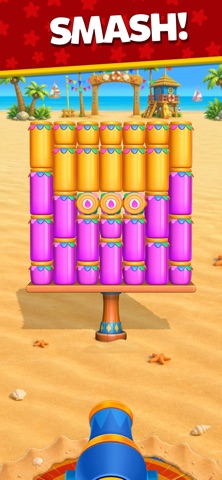
Aim at the part of the structure that changes the whole board, then tune power for the result you need—break, push, topple, or transfer force.
The best first shot changes the structure, not just the score. Before firing, separate what you see into supports, payloads, and blockers. A support holds other pieces in useful tension; a payload can fall through more targets; a blocker absorbs force without opening a route.
Plan the shot in three decisions
- Choose the result. Decide whether the ball must shatter a fragile object, push a heavy stone, topple a column, or start a debris cascade. Those are different jobs.
- Set the impact line. A flatter angle can drive force through a row; a higher arc can reach a protected support or let gravity continue the attack. The exact trajectory depends on the current level, so use the preview and the previous impact as evidence.
- Match power to the result. More power is not automatically better. A ball that exits the structure may waste its remaining force, while a controlled impact can leave debris falling through multiple targets.
Read the previous shot
After every attempt, note one cause and one correction. If the ball struck the right point but the structure barely moved, add power. If it shattered the first object and escaped, reduce power or alter the angle. If debris fell harmlessly, target a support that redirects it toward uncleared pieces. If a heavy stone blocked the cascade, move or undermine it before attacking fragile targets behind it.
Build a material map
The store description distinguishes fragile jars and heavy stones. Use that difference to assign roles before the first shot. Jars are efficient break targets but may contribute little useful mass after shattering. Stones can absorb an impact, yet their weight can become valuable if a support is removed and gravity sends them through lighter targets.
Look for a sequence rather than a single object: support, falling mass, remaining target. If breaking the support causes a stone to travel through jars, one shot has several jobs. If the same support drops everything away from the uncleared area, the visually dramatic collapse may still be strategically poor.
Protect information when attempts are limited
Do not repeat an identical miss. Keep the aiming point constant while changing power, or keep power constant while adjusting the angle. Changing both removes the evidence from the previous shot. Use a visible edge, seam, or support joint as the reference so the correction is reproducible.
Before a later shot, reassess the structure from scratch. Debris can create a new support, shield a target, or open a direct line that did not exist at the start. The correct second shot may have a completely different purpose from the first. This is especially important when a near miss moves a heavy object without destroying it.
Avoid false precision
The official listings explain the control variables but do not publish a numerical power scale, fixed physics constants, or the same ball inventory for every level. A guide that assigns exact percentages without current level evidence would be misleading. Use the live trajectory preview and visible result as the measurement system for your version.
The official store language confirms angle, power, timing, fragile jars, heavy stones, and chain destruction. It does not document a universal damage table or identical physics across every build. Version 575's notes only say bug fixes and improvements, so this page does not claim undocumented balance changes.
Return to the Smash Fest guide for verified platforms and the current store snapshot.
Sources
QUICK ANSWERS
Questions players ask next
Should I always use maximum power in Smash Fest?
No. Use enough power for the intended break or displacement; excess force can send debris away from the remaining structure instead of through it.
Where should the first shot land?
Prefer a load-bearing connection or a line that transfers force through several targets, not automatically the closest visible object.
HELP SHAPE THE NEXT UPDATE
Missing an answer—or found something outdated?
Send the exact game problem, platform, and version. Corrections are reviewed before expansion requests.